
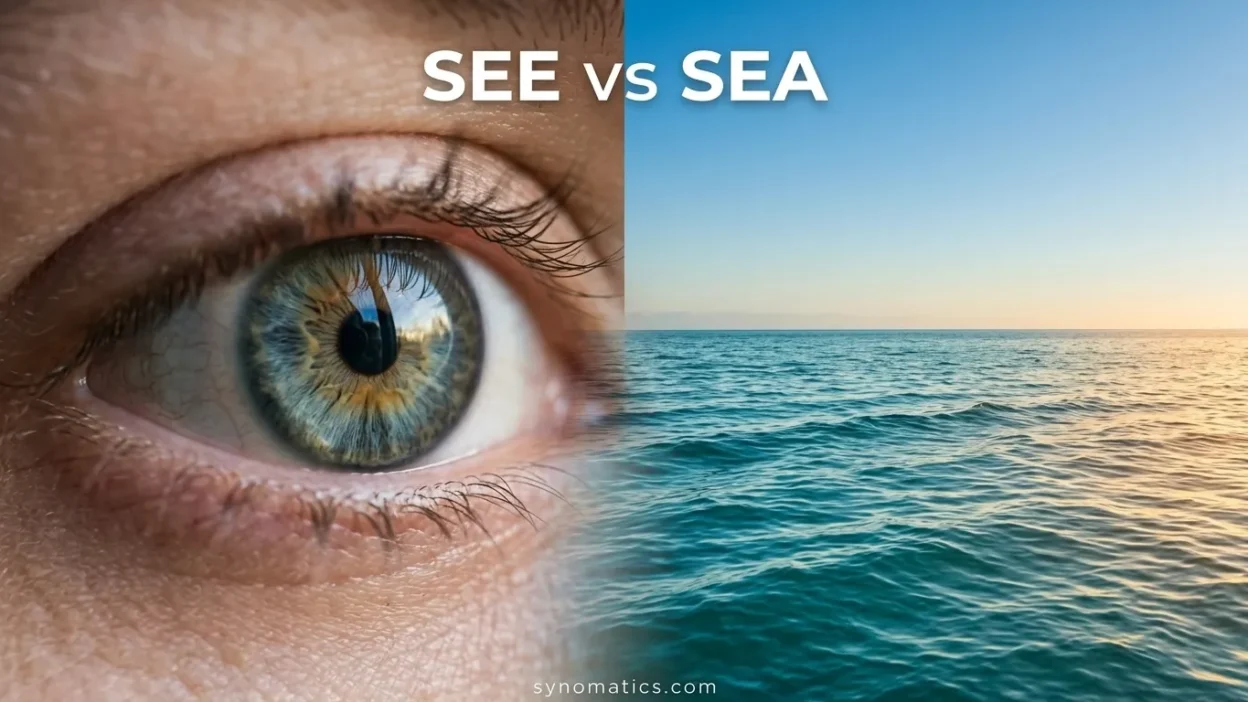
The difference between see vs sea is simple once you understand their meanings. See is a verb that means to look at something, notice something, or understand something. Sea is a noun that refers to a large body of salt water. Although these words have different meanings and spellings, they sound exactly the same in English.
For example, you might say, “I can see the sea from my window.” In this sentence, see describes what you can do with your eyes, while sea refers to the large body of water you can observe. Both words are common in everyday conversations, books, emails, and school assignments. Confusing them can change the meaning of a sentence, especially when writing.
In this guide, you will learn the definitions of see and sea, their grammatical uses, and the differences between them. You will also find practical examples, common spelling mistakes, and easy memory tricks to help you choose the correct word whenever you write or speak English.
Quick Answer: See vs Sea
See means to look at, notice, recognize, or understand something. It is a verb. Sea means a large body of salt water and is a noun. Both words are pronounced the same way, making them homophones. Remember: you see something with your eyes, and you can swim in the sea.
Why Do People Confuse See and Sea?
People often confuse see and sea because they are homophones. Homophones are words that sound alike but have different meanings and spellings.
Although see and sea are pronounced identically, they perform different grammatical functions.
- See: An action or state related to vision, noticing, or understanding.
- Sea: A large body of salt water.
For example:
- I can see the boats.
- The boats are sailing across the sea.
The first sentence describes the ability to observe something. The second identifies where the boats are sailing.
The easiest way to avoid confusion is to consider the meaning of the sentence before choosing the spelling.
What Does See Mean?
See is a verb that means to notice something with your eyes, observe something, meet someone, or understand an idea. It is one of the most frequently used verbs in English.
How to Use See in a Sentence
Use see when talking about vision, observation, meetings, or understanding.
Examples:
- I can see a bird in the tree.
- Did you see my message?
- We will see our friends tomorrow.
- I see what you mean.
- Can you see the mountains from here?
In these examples, see describes different experiences, from looking at something to understanding an explanation.
Different Forms of See
The verb see has several forms that you should know.
| Verb form | Example |
|---|---|
| Base form: see | I see a rainbow. |
| Third-person singular: sees | She sees the ocean. |
| Past tense: saw | We saw a dolphin. |
| Past participle: seen | I have seen that movie. |
| Present participle: seeing | I am seeing a doctor today. |
Important: Saw and seen are forms of the verb see, not alternative spellings of sea.
Common Expressions With See
The word see appears in many common English expressions.
- See you later: A casual way to say goodbye.
- See eye to eye: To agree with someone.
- See the point: To understand the reason or purpose.
- Let me see: A phrase used when thinking or checking something.
- See for yourself: To examine or experience something personally.
For example, “I see your point” means that you understand someone’s argument. It does not refer to looking at a physical object.
What Does Sea Mean?
Sea is a noun that refers to a large body of salt water. Seas are generally connected to the world’s oceans, although the exact geographical definition varies.
The word can also appear in expressions related to sailing, marine life, and coastal environments.
How to Use Sea in a Sentence
Use sea when referring to a body of water or something associated with it.
Examples:
- The sea looks calm today.
- We spent our holiday near the sea.
- Many fish live in the sea.
- The ship sailed across the sea.
- The children collected shells beside the sea.
In each example, sea names a place or natural feature.
Common Expressions With Sea
Here are several familiar expressions that use sea.
- At sea: On a voyage or, figuratively, confused or uncertain.
- By the sea: Near the coast.
- Sea level: The average level of the ocean’s surface used as a reference for measuring elevation.
- Sea breeze: Wind that blows from the sea toward the land.
- A sea of people: A large crowd, using sea figuratively.
For example, “I felt at sea during the first week of my new job” means that the person felt confused or uncertain.
See vs Sea: Comparison Table
| Feature | See | Sea |
|---|---|---|
| Part of speech | Verb | Noun |
| Main meaning | To look at, notice, or understand | A large body of salt water |
| Pronunciation | /siː/ | /siː/ |
| Spelling | See | Sea |
| Example | I can see the island. | The island is surrounded by the sea. |
| Related words | Saw, seen, seeing | Ocean, marine, seashore |
| Common use | Vision and understanding | Water and coastal environments |
The most important difference is their meaning and grammatical role. Even though they sound the same, they cannot usually replace one another.
When Should You Use See or Sea?
Choosing the correct word becomes easier when you identify what your sentence is describing.
Use See When Talking About Vision
If the sentence describes looking at, noticing, or observing something, use see.
Examples:
- I can see the stars tonight.
- Can you see that sign?
- She saw a butterfly in the garden.
Use See When Talking About Understanding
See can also mean to understand or recognize an idea.
Examples:
- Now I see why you were upset.
- I see what you are trying to explain.
- Do you see the difference between these words?
Use Sea When Talking About Water
If you are referring to a body of salt water, use sea.
Examples:
- The sea is beautiful at sunset.
- We went swimming in the sea.
- The sailors crossed the sea safely.
Use Sea in Related Words
The spelling sea also appears in compound words and expressions related to coastal environments.
Examples:
- Seaside
- Seawater
- Seashore
- Seabed
- Seafarer
These words refer to places, materials, or people connected with the sea.
15 Examples of See vs Sea in Sentences
The following examples show how to use both words correctly in everyday English.
1. I can see the sea from my hotel room.
See means observe, while sea means a body of water.
2. We saw dolphins swimming in the sea.
Saw is the past tense of see.
3. Can you see the boat near the shore?
The verb describes looking at the boat.
4. The sea was rough during the storm.
The noun refers to the body of water.
5. I want to see the sea for the first time.
The sentence uses both words correctly.
6. She has never seen the sea before.
Seen is the past participle of see.
7. The children played beside the sea.
Sea identifies the coastal location.
8. Did you see the beautiful sunset over the sea?
See describes observation, and sea identifies the setting.
9. I see what you mean about protecting marine life.
Here, see means understand.
10. Many ships travel across the sea every day.
Sea refers to the water used for travel.
11. We could see the island across the sea.
The verb describes what was visible.
12. The sea is home to many fascinating animals.
Sea refers to a marine environment.
13. You will see the seashore after the next turn.
See is a verb, while seashore is a compound noun.
14. I have seen pictures of the Red Sea.
Seen is a form of the verb, and Sea is part of a geographical name.
15. If you look carefully, you can see fish beneath the sea’s surface.
See describes observing, while sea’s indicates possession or association.
Common Mistakes With See and Sea
Because these words sound identical, spelling errors are easy to make. Here are the most common mistakes and how to correct them.
Mistake 1: Writing Sea Instead of See
Incorrect: I can sea the mountains.
Correct: I can see the mountains.
Use see because the sentence describes something visible.
Mistake 2: Writing See Instead of Sea
Incorrect: We went swimming in the see.
Correct: We went swimming in the sea.
Use sea because the sentence refers to a body of water.
Mistake 3: Confusing Saw and Sea
Incorrect: I sea a whale yesterday.
Correct: I saw a whale yesterday.
When describing something that happened in the past, use saw, the past tense of see.
Mistake 4: Confusing Seen and Sea
Incorrect: I have sea that movie.
Correct: I have seen that movie.
Use seen after helping verbs such as have, has, or had when forming the perfect tenses.
Mistake 5: Assuming the Words Are Interchangeable
Incorrect: The sea is beautiful, and I can sea it.
Correct: The sea is beautiful, and I can see it.
Although the words have the same pronunciation, their meanings determine which spelling is correct.
What Is an Easy Memory Trick for See vs Sea?
Try this simple memory trick:
- See = eyes. The word see contains the double letter e, which you can associate with your eyes and the act of seeing.
- Sea = water. Think of the ocean, waves, beaches, and boats when you see the word sea.
Remember this sentence:
“I can see the sea.”
It contains both words and shows the difference clearly. You use your eyes to see, and the sea is the water you observe.
See vs Sea in American and British English
There is no meaningful difference between American and British English in the spelling, meaning, or standard pronunciation of see and sea.
Both words are pronounced /siː/ in both varieties. They are homophones in standard American and British English.
Examples used in both varieties include:
- I can see the sea.
- We saw a ship at sea.
- The sea looks calm today.
Regional accents may affect the details of pronunciation, but they do not change the standard distinction between these two words.
Similar Words to See and Sea
English contains many homophones and related words that learners may confuse with see and sea.
Sight
Sight is a noun referring to the ability to see or something that can be seen.
Example: The sunset was a beautiful sight.
Sight vs See
See describes an action or experience, while sight usually names the ability to see or the thing observed.
Example: I can see the mountains. The mountains are a wonderful sight.
Ocean
An ocean is one of the major interconnected bodies of salt water covering much of Earth’s surface.
Example: The Pacific Ocean is enormous.
Sea and ocean are related, but they are not always interchangeable in geographical contexts.
Shore
The shore is the land along the edge of a sea, lake, or other body of water.
Example: We walked along the shore.
Sea vs See vs C
The letter C is also pronounced /siː/ in English, making it another homophone of see and sea.
Examples:
- I can see the boat.
- The boat is sailing on the sea.
- The letter C is the third letter of the English alphabet.
The spelling and meaning depend on the context.
FAQs:
1. What is the difference between see and sea?
See is a verb meaning to look at, notice, or understand something. Sea is a noun referring to a large body of salt water. Both words are pronounced the same way but have different spellings and meanings.
2. Are see and sea homophones?
Yes. See and sea are homophones because they have the same pronunciation but different spellings and meanings.
3. Is it correct to say “I can see the sea”?
Yes. “I can see the sea” is grammatically correct. See is the verb describing what you observe, and sea is the noun identifying the body of water.
4. What is the past tense of see?
The past tense of see is saw.
Example: I saw a beautiful boat yesterday.
The past participle is seen, as in “I have seen that boat before.”
5. How do you remember the spelling of see and sea?
Associate see with your eyes and the act of looking. Associate sea with water, waves, and oceans. The sentence “I can see the sea” is a simple way to remember both spellings.
6. Do see and sea sound the same in American and British English?
Yes. Both words are normally pronounced /siː/ in American and British English. Regional accents may vary slightly, but the words remain homophones.
7. Can sea be used as a verb?
Sea is normally used as a noun, not as a standard verb meaning to look at something. For that meaning, use see. For example, write “I can see the ship,” not “I can sea the ship.”
Remember This
- See is a verb related to vision, observation, and understanding.
- Sea is a noun referring to a large body of salt water.
- Both words sound the same but have different spellings and meanings.
- Saw is the past tense of see.
- Seen is the past participle of see.
- Use context to determine which word belongs in your sentence.
- Remember the example: “I can see the sea.”
Conclusion
Learning the difference between see and sea is an easy way to improve your English spelling and writing. Although the words sound identical, their meanings are completely different. See describes looking at or understanding something, while sea refers to a large body of salt water.
Whenever you are unsure which word to use, read your sentence carefully and consider its meaning. If you are talking about observing something, choose see. If you are talking about water, choose sea. With a little practice and the examples in this guide, you can use both words correctly and confidently.