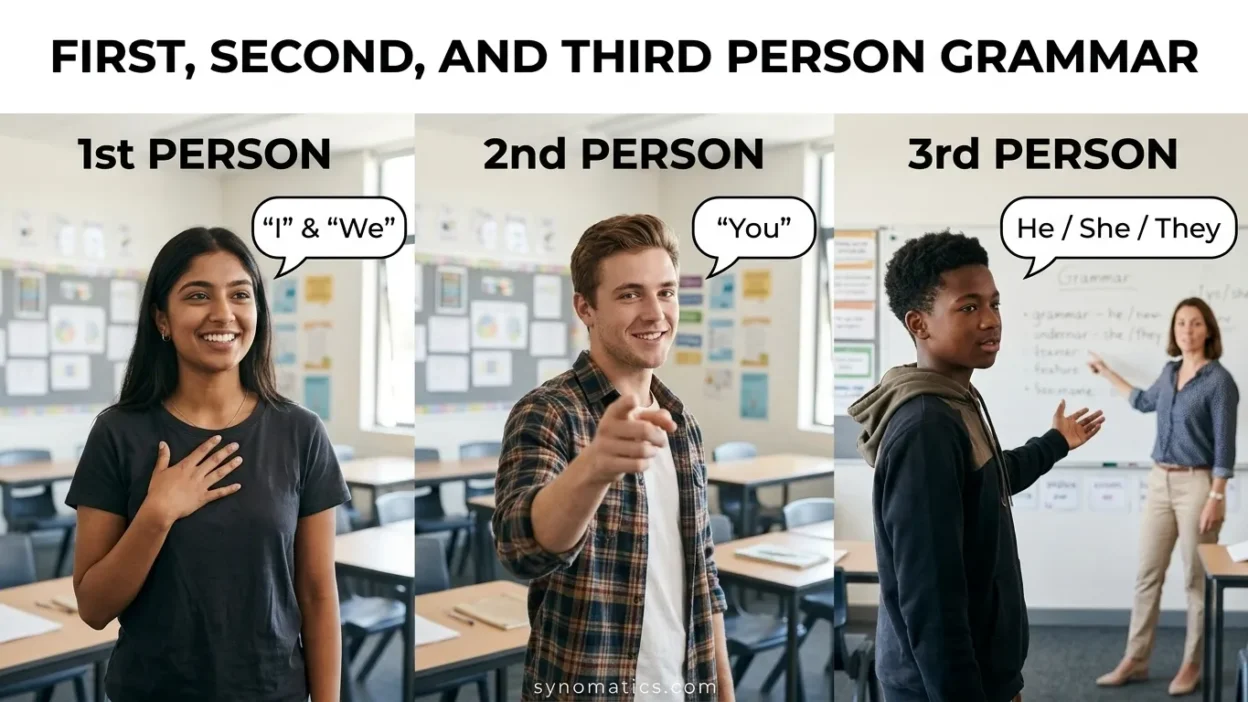
Understanding first, second, and third person grammar is essential for writing clear sentences and speaking English correctly. These three grammatical perspectives show who is speaking, who is being addressed, and who or what is being discussed. First person refers to the speaker, second person refers to the person being addressed, and third person refers to someone or something being discussed.
For example, “I like reading” uses first person, “You like reading” uses second person, and “She likes reading” uses third person. Although these sentences express a similar idea, their subjects change the grammatical person. This difference can also affect verb forms, pronouns, and sentence structure.
Whether you are learning English as a second language, improving your writing, or studying grammar for school, understanding these three perspectives will help you construct accurate sentences. This guide explains first, second, and third person grammar with simple definitions, comparison tables, practical examples, common mistakes, and easy memory tricks.
Quick Answer
First, second, and third person are three grammatical perspectives. First person refers to the speaker (I, we), second person refers to the person being addressed (you), and third person refers to other people, animals, places, or things (he, she, it, they). These perspectives help determine pronoun choice and, in some cases, verb agreement.
Why Do People Confuse First, Second, and Third Person?
People often confuse these grammatical persons because they describe similar situations from different perspectives. The main difference is who the sentence focuses on.
Consider these examples:
- First person: I am learning English.
- Second person: You are learning English.
- Third person: He is learning English.
All three sentences describe someone learning English, but each uses a different subject.
Another reason for confusion is that pronouns change depending on the grammatical person. For example, “I” refers to the speaker, while “me” is used when the speaker receives an action. Similarly, “he” and “him” have different grammatical roles.
Verb agreement can also cause mistakes. In the simple present tense, we say “I work” but “she works.” Recognizing the subject’s grammatical person helps you choose the correct verb form.
What Is First Person Grammar?
First person grammar refers to the person or people speaking or writing. It allows speakers and writers to express their own thoughts, experiences, feelings, and actions.
First person commonly uses the pronouns I, me, my, mine, we, us, our, and ours.
First Person Singular
First person singular refers to one speaker.
Examples:
- I enjoy reading novels.
- I am preparing for my examination.
- My brother gave me a book.
- This notebook is mine.
In these sentences, the speaker is talking about themselves.
First Person Plural
First person plural refers to the speaker and at least one other person.
Examples:
- We study English together.
- Our teacher explains grammar clearly.
- The coach gave us new instructions.
- This classroom is ours.
The word “we” includes the speaker and other people. Depending on the context, it may refer to two people, a small group, or a larger community.
When Is First Person Used?
First person is common in:
- Personal stories and autobiographies
- Diaries and personal reflections
- Conversations about personal experiences
- Opinion essays when personal viewpoints are appropriate
- Research writing when the author needs to describe their actions or decisions
Example: “I believe regular practice improves English skills.”
First person is useful when the writer wants to communicate personal involvement or make it clear who performed an action.
What Is Second Person Grammar?
Second person grammar refers to the person or people being addressed. It is commonly used when speaking directly to someone or giving instructions.
The main second-person pronoun is you. Other related forms include your and yours.
Second Person Singular
In modern English, “you” can refer to one person.
Examples:
- You are my best friend.
- You should practice every day.
- Your answer is correct.
- This seat is yours.
Second Person Plural
“You” can also refer to two or more people.
Examples:
- You are all welcome here.
- You should complete your assignments.
- Your presentations were excellent.
- These books are yours.
English uses “you” for both singular and plural subjects. Some regional varieties use expressions such as “you all” or “y’all” to make the plural meaning clearer.
When Is Second Person Used?
Second person is especially common in:
- Direct conversations
- Instructions and commands
- Tutorials and how-to guides
- Advice and recommendations
- Questions addressed to a reader or listener
Examples:
- You should read the instructions carefully.
- Turn left at the next street.
- If you practice regularly, you will improve.
Commands often omit the subject “you.” For example, “Close the door” is understood as an instruction addressed to someone, even though the pronoun is not written.
What Is Third Person Grammar?
Third person grammar refers to the person, animal, place, or thing being discussed rather than the speaker or the person being addressed.
Third person commonly uses he, she, it, they, him, her, them, his, hers, its, their, and theirs. Names and noun phrases can also function as third-person subjects.
Third Person Singular
Third person singular refers to one person, animal, place, or thing.
Examples:
- He plays football every weekend.
- She speaks English fluently.
- It looks beautiful.
- Sarah works at a hospital.
- The dog sleeps near the door.
In the simple present tense, most third-person singular subjects take a verb ending in -s or -es.
Examples:
- I read every day.
- She reads every day.
- They watch television.
- He watches television.
This rule is especially important for English learners.
Third Person Plural
Third person plural refers to two or more people, animals, places, or things.
Examples:
- They live in London.
- The students study together.
- My friends enjoy music.
- The birds are flying over the trees.
Notice that “they” can also refer to one person when the person’s gender is unknown, irrelevant, or when that person uses they/them pronouns.
Example: “Someone left their phone on the table. They may return for it.”
This is a standard use of singular “they” in modern English.
When Is Third Person Used?
Third person is common in:
- Fiction and storytelling
- News reports
- Academic explanations
- Descriptions of people and places
- Essays about general topics
- Biographies and historical accounts
Example: “Marie Curie made important contributions to science.”
The sentence discusses Marie Curie rather than addressing her directly or describing the speaker’s own actions.
First Person vs Second Person vs Third Person: Comparison Table
| Feature | First Person | Second Person | Third Person |
|---|---|---|---|
| Meaning | The speaker | The person addressed | The person or thing discussed |
| Singular subject | I | You | He, she, it |
| Plural subject | We | You | They |
| Object pronouns | Me, us | You | Him, her, it, them |
| Possessive examples | My, mine, our, ours | Your, yours | His, her, hers, its, their, theirs |
| Example | I am ready. | You are ready. | She is ready. |
| Common use | Personal experiences | Direct communication | Descriptions and storytelling |
The most important difference is perspective. First person involves the speaker, second person addresses someone, and third person discusses someone or something else.
When Should You Use Each Grammatical Person?
Choosing the correct grammatical person depends on your purpose, audience, and writing style.
Use First Person to Talk About Yourself
Use first person when discussing your own experiences, opinions, feelings, or actions.
Examples:
- I enjoyed the movie.
- We completed the project.
- I learned three new words today.
First person is particularly useful for personal narratives and reflective writing.
Use Second Person to Address the Reader
Use second person when giving advice, explaining steps, or speaking directly to an audience.
Examples:
- You can improve your vocabulary by reading.
- You should check your answers before submitting them.
- Follow these steps to create an account.
Second person makes instructions direct and easy to follow.
Use Third Person to Discuss Others
Use third person when describing someone, reporting information, or telling a story about other people.
Examples:
- Ahmed studies engineering.
- The company launched a new product.
- They visited the museum yesterday.
Third person is often appropriate when you want to focus on a person, group, or subject rather than the reader or writer.
Can You Mix Different Grammatical Persons?
Yes. You can use more than one grammatical person in the same paragraph when the meaning is clear.
Example: “I explained the rules to Sara, and she showed you how to apply them.”
However, avoid changing perspectives unnecessarily in formal writing because it can confuse readers.
15 Examples of First, Second, and Third Person Grammar
The following examples show how grammatical person changes the subject and perspective.
| First Person | Second Person | Third Person |
|---|---|---|
| I am happy. | You are happy. | He is happy. |
| I like coffee. | You like coffee. | She likes coffee. |
| We play football. | You play football. | They play football. |
| I am studying English. | You are studying English. | He is studying English. |
| We went to school. | You went to school. | They went to school. |
| I have a new book. | You have a new book. | She has a new book. |
| We are ready. | You are ready. | They are ready. |
| I enjoy music. | You enjoy music. | Sarah enjoys music. |
| We watched a movie. | You watched a movie. | They watched a movie. |
| I will call you. | You will call me. | He will call her. |
Here are five more examples showing how the grammatical person works in everyday situations.
- First person: I forgot my umbrella.
- Second person: You forgot your umbrella.
- Third person: Daniel forgot his umbrella.
- First person plural: We are going to the library.
- Third person plural: The children are going to the library.
These examples also show that grammatical person affects pronouns and sometimes verb forms, but it does not always change the verb. For instance, the simple past-tense verb “forgot” remains the same for all three persons.
Common Mistakes in First, Second, and Third Person Grammar
Understanding the basic definitions is important, but learners also need to recognize common grammatical errors.
Mistake 1: Using the Wrong Verb Form
Incorrect: She walk to school every morning.
Correct: She walks to school every morning.
Explanation: In the simple present tense, third-person singular subjects usually require an -s or -es ending on the main verb.
Mistake 2: Confusing Subject and Object Pronouns
Incorrect: Me am ready.
Correct: I am ready.
Explanation: Use “I” as a subject and “me” as an object.
Another example:
- Correct: She called me.
- Incorrect: Her called I.
Mistake 3: Mixing Perspectives Without a Clear Reason
Confusing: I believe you should study hard because we need to pass your examination.
Clearer: I believe you should study hard because you need to pass your examination.
Explanation: Keep the perspective consistent when the meaning does not require a change.
Mistake 4: Assuming “You” Is Always Singular
Incorrect assumption: “You” can refer only to one person.
Correct understanding: “You” can refer to one person or several people.
Example: “You are invited to the meeting” could address one individual or an entire group.
Mistake 5: Forgetting That Names Use Third Person
Incorrect: Maria go to work every day.
Correct: Maria goes to work every day.
Explanation: A person’s name generally functions as a third-person subject. “Maria” is grammatically equivalent to “she” in this sentence.
Mistake 6: Thinking Third Person Always Means a Man or Woman
Third person also includes objects, animals, groups, and people whose gender is unknown or irrelevant.
Examples:
- It is raining.
- The cat is sleeping.
- They are waiting outside.
- The package arrived yesterday.
Easy Memory Trick for First, Second, and Third Person
Remember this simple sequence:
- First person = I or we: Think about yourself and your group.
- Second person = you: Think about the person you are talking to.
- Third person = he, she, it, or they: Think about someone or something being discussed.
You can also remember the sequence by imagining a conversation:
- I speak.
- You listen.
- They are the people we discuss.
For a quick grammar check, ask yourself three questions:
- Am I talking about myself? Use first person.
- Am I talking directly to someone? Use second person.
- Am I talking about another person or thing? Use third person.
This simple method helps you identify grammatical person in most everyday sentences.
American vs British English: Does Grammatical Person Change?
The basic rules for first, second, and third person are the same in American and British English. Both varieties use pronouns such as “I,” “you,” “he,” “she,” “we,” and “they.”
However, some regional differences affect how speakers express plural “you” or use collective nouns.
For example:
- American English: “You all are invited.”
- Informal American English: “Y’all are invited.”
- British English: “You are all invited.”
These expressions can address multiple people, but their formality and regional use differ.
Collective nouns can also affect verb agreement. In American English, a collective noun such as “the team” is commonly treated as singular when the group acts as one unit: “The team is ready.” British English sometimes uses singular or plural agreement depending on whether the group is viewed as a unit or as individual members.
These differences do not change the fundamental definitions of grammatical person.
Similar Grammar Terms You Should Know
Several related grammar concepts can help you understand grammatical person more clearly.
Subject Pronouns
Subject pronouns perform the action or identify who or what the sentence is about.
Examples:
- First person: I, we
- Second person: you
- Third person: he, she, it, they
Example: “They are playing outside.”
Object Pronouns
Object pronouns receive an action or follow certain prepositions.
Examples:
- First person: me, us
- Second person: you
- Third person: him, her, it, them
Example: “The teacher helped us.”
Possessive Pronouns and Determiners
These forms express ownership or association.
Examples:
- First person: mine, ours, my, our
- Second person: yours, your
- Third person: his, hers, theirs, her, their
Example: “This is my bag, and that one is yours.”
Strictly speaking, “my,” “your,” “our,” and “their” are possessive determiners because they accompany nouns. “Mine,” “yours,” “ours,” and “theirs” are possessive pronouns.
Grammatical Number
Grammatical number distinguishes between singular and plural forms.
Examples:
- Singular: I, he, she, it
- Plural: we, they
“You” can be singular or plural, depending on the context.
Point of View in Writing
Point of view refers to the perspective from which a story or piece of writing is presented.
- First-person point of view: “I opened the door.”
- Second-person point of view: “You open the door.”
- Third-person point of view: “She opened the door.”
First-person and third-person narration are common in fiction. Second-person narration is often used in interactive writing, instructions, and stories that address the reader directly.
FAQs:
1. What is the difference between first, second, and third person?
First person refers to the speaker, second person refers to the person being addressed, and third person refers to someone or something being discussed. Their common subject pronouns are “I/we,” “you,” and “he/she/it/they,” respectively.
2. Is “you” first person or second person?
“You” is a second-person pronoun. It refers to the person or people being addressed, whether the sentence is speaking to one individual or a group.
3. Is “we” first person or third person?
“We” is a first-person plural pronoun. It refers to the speaker and at least one other person.
4. Is “they” always third person plural?
No. “They” commonly refers to multiple people, but it can also refer to one person. Singular “they” is used when a person’s gender is unknown, irrelevant, or when the person uses they/them pronouns.
5. What are first-person, second-person, and third-person pronouns?
First-person pronouns include “I,” “me,” “we,” and “us.” Second-person pronouns include “you.” Third-person pronouns include “he,” “she,” “it,” “they,” “him,” “her,” and “them.”
6. Which grammatical person is used in academic writing?
Academic writing can use first, second, or third person, depending on the purpose and assignment. First person is appropriate for explaining the researcher’s methods or perspective, while third person is useful for discussing people and concepts. Second person is often avoided in formal academic writing unless directly addressing the reader is appropriate.
7. How do you identify grammatical person in a sentence?
Find the subject and determine who it refers to. If the subject is the speaker, it is first person. If it addresses the listener, it is second person. If it discusses someone or something else, it is third person.
Remember This
- First person: I, me, we, us — the speaker.
- Second person: You — the person being addressed.
- Third person: He, she, it, they — the person or thing being discussed.
- Third-person singular subjects usually take an -s or -es ending in the simple present tense.
- “You” can refer to one person or several people.
- Singular “they” is also grammatically correct.
- Choose the grammatical person that best fits your message and keep your perspective clear.
Conclusion
First, second, and third person grammar helps you understand who is speaking, who is being addressed, and who or what is being discussed. First person uses forms such as “I” and “we,” second person uses “you,” and third person commonly uses “he,” “she,” “it,” and “they.” Learning these differences makes it easier to choose the right pronouns and construct clear sentences.
The best way to master grammatical person is to practice with simple examples and notice how the subject changes the perspective of a sentence. Remember that verb forms can also change, especially with third-person singular subjects in the simple present tense. With regular practice, you can use all three grammatical persons confidently in conversations, essays, stories, and everyday writing.