
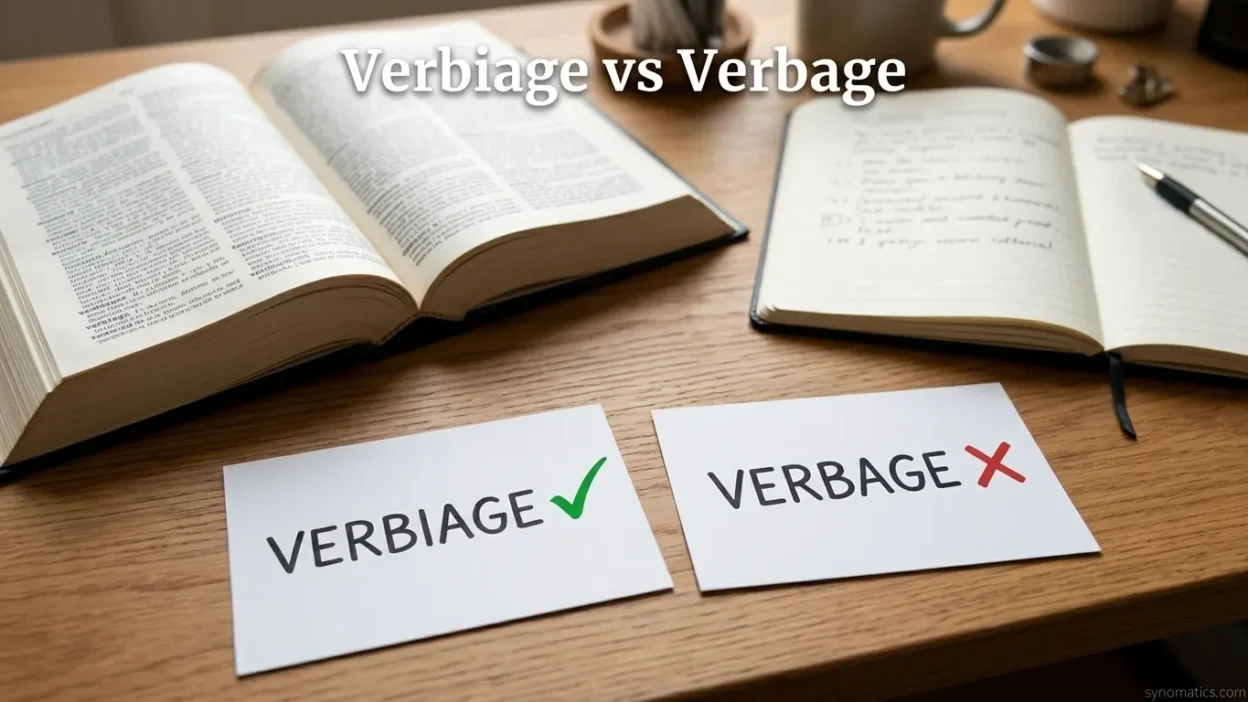
Choosing between verbiage vs verbage can be confusing because the two words look almost identical. However, only one is the standard spelling in modern English. Verbiage is the correct and widely accepted spelling, while verbage is generally considered a misspelling. The word verbiage refers to the words used to express an idea, especially when the language is unnecessarily complicated, wordy, or excessive.
Understanding the difference helps you write more clearly in emails, essays, reports, and everyday conversations. Although verbage may appear in informal writing, professional documents, or online discussions, it is not the standard form you should use. Learning the correct spelling is particularly useful for students, writers, editors, and anyone who wants to improve their English vocabulary.
Quick Answer
Verbiage is the correct spelling, while verbage is a common misspelling. Verbiage refers to the words or language used to communicate an idea, often suggesting excessive or unnecessarily complicated wording. Use verbiage in academic writing, professional communication, and everyday English. Remember the extra i after the b.
Why Do People Confuse Verbiage and Verbage?
People often confuse these words because they look and sound similar. Both are associated with the word verb and with the general idea of language or wording. When speaking quickly, the difference between their written forms may not be obvious.
Another reason is that English spelling does not always match pronunciation perfectly. People may write verbage because it seems like a logical spelling of the word they hear.
However, the standard English spelling is verbiage. Remembering this form helps you avoid spelling errors in school assignments, business emails, articles, and other written communication.
What Does Verbiage Mean?
Verbiage is a noun that refers to the words or language used to express something. It often describes language that contains too many words or uses unnecessary complexity.
The word can have a neutral meaning when referring to someone’s wording, but it frequently carries a negative meaning when the language is unnecessarily long or complicated.
Examples of Verbiage in Sentences
- The contract contains legal verbiage that is difficult to understand.
- Please remove the unnecessary verbiage from your report.
- The instructions were clear and contained very little confusing verbiage.
- The manager asked us to simplify the verbiage in the presentation.
- Good writing communicates ideas without excessive verbiage.
In these examples, verbiage describes the language or wording used to communicate information.
What Does Verbage Mean?
Verbage is generally considered a nonstandard spelling or misspelling of verbiage. It is sometimes used informally when someone means the wording or language of a statement, document, or conversation.
For example:
- Incorrect: The report contains too much verbage.
- Correct: The report contains too much verbiage.
Although readers may understand what someone means by verbage, the spelling is not recommended in standard English writing. In academic, business, and professional contexts, choose verbiage.
Verbiage vs Verbage: Comparison Table
| Feature | Verbiage | Verbage |
|---|---|---|
| Spelling status | Standard and correct | Generally nonstandard |
| Part of speech | Noun | Nonstandard spelling of a noun |
| Meaning | Words or language used to express something | Usually intended to mean verbiage |
| Formal writing | Recommended | Avoid |
| Academic writing | Correct choice | Incorrect choice |
| Example | The verbiage is confusing. | The verbage is confusing. |
| Best use | Standard English communication | Avoid in edited writing |
The main difference is spelling, not meaning. When you want to refer to wording or excessive language, verbiage is the form to use.
When Should You Use Verbiage or Verbage?
When to Use Verbiage
Use verbiage whenever you need the standard English word for wording or language. It is appropriate in formal and informal contexts.
Use it when discussing:
- Legal documents and contracts
- Business emails and reports
- Academic essays and research papers
- Instructions and presentations
- Wordy or complicated explanations
- The wording of policies, agreements, or announcements
Examples:
- The lawyer reviewed the verbiage in the agreement.
- The teacher advised students to avoid unnecessary verbiage.
- We need to make the policy’s verbiage easier to understand.
When to Use Verbage
In standard English writing, avoid verbage. If you encounter it in a message or document, it is usually intended to mean verbiage.
For professional communication, proofreading, and published content, replace verbage with verbiage.
12 Examples of Verbiage vs Verbage in Sentences
The following examples show how to use the correct spelling naturally.
- Correct: The verbiage in the contract was difficult to understand.
Incorrect: The verbage in the contract was difficult to understand. - Correct: Please simplify the verbiage in your email.
Incorrect: Please simplify the verbage in your email. - Correct: The report contains unnecessary verbiage.
Incorrect: The report contains unnecessary verbage. - Correct: The company updated the verbiage on its website.
Incorrect: The company updated the verbage on its website. - Correct: The teacher asked us to remove excessive verbiage from our essays.
Incorrect: The teacher asked us to remove excessive verbage from our essays. - Correct: The legal verbiage made the agreement seem complicated.
Incorrect: The legal verbage made the agreement seem complicated. - Correct: Clear instructions require little unnecessary verbiage.
Incorrect: Clear instructions require little unnecessary verbage. - Correct: The editor revised the verbiage to improve readability.
Incorrect: The editor revised the verbage to improve readability. - Correct: The policy uses formal verbiage to explain its requirements.
Incorrect: The policy uses formal verbage to explain its requirements. - Correct: Avoid excessive verbiage when writing a professional letter.
Incorrect: Avoid excessive verbage when writing a professional letter. - Correct: The presentation included technical verbiage that confused the audience.
Incorrect: The presentation included technical verbage that confused the audience. - Correct: We changed the verbiage to make the announcement more welcoming.
Incorrect: We changed the verbage to make the announcement more welcoming.
These examples demonstrate a simple rule: use verbiage whenever you mean wording or language.
Common Mistakes With Verbiage and Verbage
Several mistakes can make this word difficult to use correctly.
1. Leaving Out the Letter I
The most common mistake is writing verbage instead of verbiage.
- Incorrect: The document contains confusing verbage.
- Correct: The document contains confusing verbiage.
2. Assuming Both Spellings Are Equally Correct
The fact that readers understand verbage does not make it a standard spelling. In edited English, verbiage is the preferred form.
3. Using Verbiage Only to Mean Bad Writing
Although verbiage often suggests excessive wording, it can also refer more generally to the language used in a document or statement. Its precise meaning depends on context.
4. Confusing Verbiage With Vocabulary
Verbiage concerns wording or language used in a particular expression. Vocabulary refers to the words a person knows or the words associated with a language, subject, or text.
For example:
- The contract’s verbiage is complicated.
- Her English vocabulary is extensive.
What Is an Easy Memory Trick for Verbiage?
Use this simple memory trick: Verbiage has an extra “i.”
Think of the correct spelling as:
VERB + I + AGE = VERBIAGE
The formula is only a memory aid, not a literal explanation of the word’s historical formation. The important point is to remember the i between the b and the a.
You can also connect verbiage with language. Both relate to words and communication, making it easier to remember the correct spelling.
Whenever you are unsure, pause and check whether your word contains the extra i.
Verbiage vs Verbage in American and British English
The standard spelling is verbiage in both American and British English. There is no usual regional spelling difference that makes verbage the preferred form in either variety.
You can confidently write verbiage in American business emails, British academic assignments, international reports, and other forms of standard English communication.
Examples:
- American English: The verbiage in the agreement needs revision.
- British English: The verbiage in the agreement needs revision.
The spelling remains the same. Differences in pronunciation or individual writing habits do not change the standard spelling.
Similar Words to Verbiage
Several English words have meanings related to verbiage, but they are not always interchangeable.
| Word | Meaning | Example |
|---|---|---|
| Wording | The way something is expressed in words | The wording of the notice is clear. |
| Language | Words and expressions used to communicate | The language in the report is formal. |
| Terminology | Specialized words used in a subject | The medical terminology was unfamiliar. |
| Vocabulary | The words known or used by a person or group | She has a strong vocabulary. |
| Wordiness | The use of more words than necessary | The essay suffers from wordiness. |
| Verbosity | The quality of using too many words | The explanation is full of verbosity. |
| Phrasing | The particular way something is expressed | The phrasing sounds polite. |
| Jargon | Specialized language used by a particular group | The article contains technical jargon. |
If you mean unnecessary or excessive wording, wordiness or verbosity may express your meaning more precisely. If you simply mean the way a statement is written, wording may be a better choice.
FAQs:
1. Is verbiage or verbage correct?
Verbiage is the correct standard spelling. Verbage is generally considered a misspelling and should be avoided in formal and professional writing.
2. What does verbiage mean in simple words?
Verbiage means the words or language used to express an idea. It often refers to unnecessary, excessive, or complicated wording, especially in documents and explanations.
3. Is verbage ever acceptable?
Verbage appears in informal writing, but it is not the standard spelling. If you want to write correctly in English, use verbiage instead.
4. Is verbiage a negative word?
Not always. Verbiage can simply refer to the wording used in a statement or document. However, it often has a negative connotation when describing language that is too complicated or unnecessarily wordy.
5. What is the plural of verbiage?
Verbiage is generally used as an uncountable noun, so it usually does not need a plural form. You can say “the verbiage in these documents” rather than “verbiages.”
6. What is another word for verbiage?
Depending on the context, alternatives include wording, language, phrasing, verbosity, and wordiness. Use wording for neutral descriptions and wordiness when emphasizing unnecessary words.
7. Is verbiage spelled the same in American and British English?
Yes. Verbiage is the standard spelling in both American and British English. Neither variety generally uses verbage as the correct standard form.
Remember This
- Verbiage = the correct spelling.
- Verbage = generally a misspelling.
- Verbiage refers to wording or language and often suggests excessive words.
- The standard spelling includes an i after the b.
- Use verbiage in academic, professional, and everyday writing.
Conclusion
Understanding the difference between verbiage and verbage is simple once you remember the correct spelling. Although both forms may appear in written communication, verbiage is the standard English word for the wording or language used to express an idea. It can describe ordinary wording or language that is unnecessarily complicated.
To improve your writing, use verbiage in professional emails, essays, reports, and other documents. If your goal is to describe language that uses too many words, you can also consider wordiness or verbosity. Remember the extra i, and you will be less likely to make this common spelling mistake.