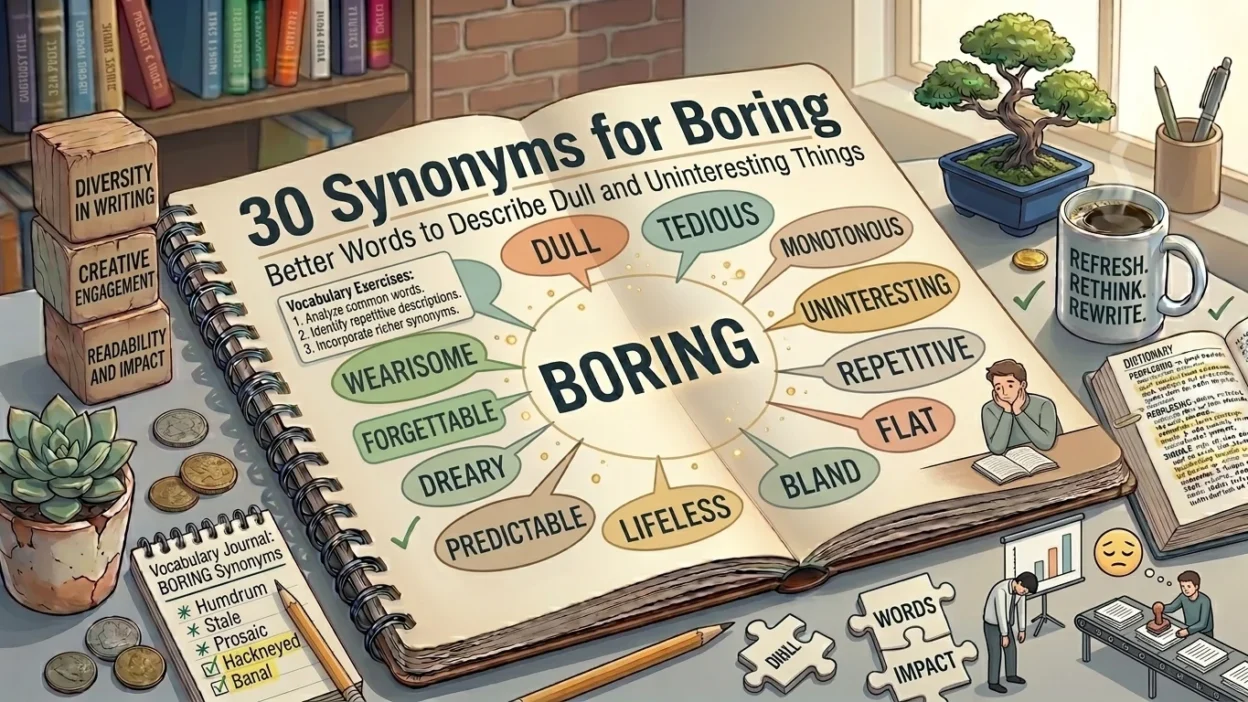
The word boring is commonly used to describe something that is not interesting, exciting, or enjoyable. It can refer to a book, movie, class, conversation, activity, or even a person who fails to keep others engaged.
While the word is simple and useful, using it repeatedly can make your writing sound repetitive. Learning synonyms for boring helps students, ESL learners, writers, and content creators express different levels of dullness and lack of interest. Choosing the right synonym makes your writing more descriptive and helps readers better understand what you mean.
In this guide, you will learn the meaning of boring, explore 30 useful synonyms, and discover when each alternative works best.
What Does “Boring” Mean?
The word boring describes something that fails to capture attention or interest. It often makes people feel tired, uninterested, or distracted.
Examples:
- The lecture was boring.
- We watched a boring movie.
- The meeting became boring after an hour.
The meaning of boring depends on the context. A task may be dull because it is repetitive, while a conversation may be boring because it lacks excitement.
30 Synonyms for Boring
1. Dull
Meaning: Not interesting or exciting.
Example Sentence: The presentation was dull.
Best Usage Context: General situations.
2. Tedious
Meaning: Long, repetitive, and tiring.
Example Sentence: Completing the paperwork was tedious.
Best Usage Context: Tasks and work.
3. Monotonous
Meaning: Repeating the same thing over and over.
Example Sentence: The machine made a monotonous sound.
Best Usage Context: Work and routines.
4. Uninteresting
Meaning: Not attracting attention.
Example Sentence: I found the article uninteresting.
Best Usage Context: General descriptions.
5. Tiresome
Meaning: Causing boredom because it lasts too long.
Example Sentence: The discussion became tiresome.
Best Usage Context: Conversations and activities.
6. Repetitive
Meaning: Happening again and again.
Example Sentence: The exercises felt repetitive.
Best Usage Context: Work and learning.
7. Wearisome
Meaning: Making someone feel tired or bored.
Example Sentence: The long journey became wearisome.
Best Usage Context: Long activities.
8. Dreary
Meaning: Dull and lacking excitement.
Example Sentence: It was a dreary afternoon.
Best Usage Context: Weather and moods.
9. Dry
Meaning: Serious and not entertaining.
Example Sentence: The lecture was dry but informative.
Best Usage Context: Education and presentations.
10. Flat
Meaning: Lacking energy or excitement.
Example Sentence: The performance felt flat.
Best Usage Context: Entertainment.
11. Lifeless
Meaning: Without energy or interest.
Example Sentence: The speech sounded lifeless.
Best Usage Context: Performances.
12. Bland
Meaning: Lacking excitement or variety.
Example Sentence: The story was bland.
Best Usage Context: Writing, food, and design.
13. Colorless
Meaning: Lacking excitement or personality.
Example Sentence: His explanation was colorless.
Best Usage Context: Writing and speech.
14. Ordinary
Meaning: Not special or exciting.
Example Sentence: It was an ordinary movie.
Best Usage Context: Everyday descriptions.
15. Predictable
Meaning: Easy to guess because nothing unexpected happens.
Example Sentence: The ending was predictable.
Best Usage Context: Stories and films.
16. Sleepy
Meaning: Making people feel sleepy.
Example Sentence: The quiet room felt sleepy.
Best Usage Context: Atmosphere.
17. Mind-numbing
Meaning: Extremely boring.
Example Sentence: The repetitive task was mind-numbing.
Best Usage Context: Informal conversations.
18. Stale
Meaning: No longer fresh or exciting.
Example Sentence: The jokes became stale.
Best Usage Context: Ideas and entertainment.
19. Routine
Meaning: Done regularly without excitement.
Example Sentence: The routine work became boring.
Best Usage Context: Daily activities.
20. Mechanical
Meaning: Done without feeling or creativity.
Example Sentence: His speech sounded mechanical.
Best Usage Context: Behavior and work.
21. Uneventful
Meaning: Nothing exciting happens.
Example Sentence: It was an uneventful weekend.
Best Usage Context: Experiences.
22. Plain
Meaning: Simple without anything exciting.
Example Sentence: The design looked plain.
Best Usage Context: Appearance and style.
23. Forgettable
Meaning: Not memorable.
Example Sentence: The film was forgettable.
Best Usage Context: Entertainment.
24. Humdrum
Meaning: Ordinary and lacking excitement.
Example Sentence: He wanted to escape his humdrum routine.
Best Usage Context: Daily life.
25. Slow-moving
Meaning: Progressing very slowly.
Example Sentence: The movie was slow-moving.
Best Usage Context: Films and stories.
26. Spiritless
Meaning: Without enthusiasm or energy.
Example Sentence: The performance was spiritless.
Best Usage Context: Performances.
27. Uninspiring
Meaning: Failing to motivate or excite.
Example Sentence: The presentation was uninspiring.
Best Usage Context: Work and education.
28. Passive
Meaning: Showing little energy or action.
Example Sentence: The discussion remained passive.
Best Usage Context: Meetings and conversations.
29. Unexciting
Meaning: Not enjoyable or thrilling.
Example Sentence: The event was unexciting.
Best Usage Context: Activities and events.
30. Trivial
Meaning: Too small or unimportant to be interesting.
Example Sentence: They argued over trivial matters.
Best Usage Context: Discussions and issues.
Comparison Table: When to Use Different Synonyms for Boring
| Synonym | Meaning Focus | Best Use |
|---|---|---|
| Dull | General lack of interest | Everyday use |
| Tedious | Long and repetitive | Tasks and work |
| Monotonous | Same thing repeated | Routines |
| Bland | Lacking variety | Writing and food |
| Predictable | Easy to guess | Stories |
| Dreary | Sad and dull | Weather and mood |
| Forgettable | Not memorable | Movies and books |
| Uninspiring | Lacks motivation | Presentations |
How to Choose the Right Synonym for Boring
For Repetitive Tasks
Use:
- Tedious
- Monotonous
- Repetitive
- Wearisome
These words describe work or activities that become tiring over time.
For Entertainment
Use:
- Dull
- Flat
- Predictable
- Forgettable
These are suitable for movies, books, shows, and games.
For Conversations and Presentations
Use:
- Dry
- Lifeless
- Uninspiring
- Colorless
These words describe communication that fails to keep attention.
For Everyday Situations
Use:
- Ordinary
- Humdrum
- Plain
- Uneventful
These describe experiences that lack excitement.
Why Learning Synonyms for Boring Matters
Learning different alternatives helps you avoid repeating the word boring and makes your writing more engaging. Each synonym expresses a different level or type of dullness, allowing you to communicate more clearly.
For students, ESL learners, writers, and content creators, expanding your vocabulary improves both written and spoken English.
Conclusion
Learning synonyms for boring helps you describe dull activities, repetitive tasks, and uninteresting experiences with greater accuracy. Words like dull, tedious, monotonous, and uninspiring make your writing more expressive and varied.
A stronger vocabulary allows you to choose the best word for every situation and keep your writing interesting for readers.