
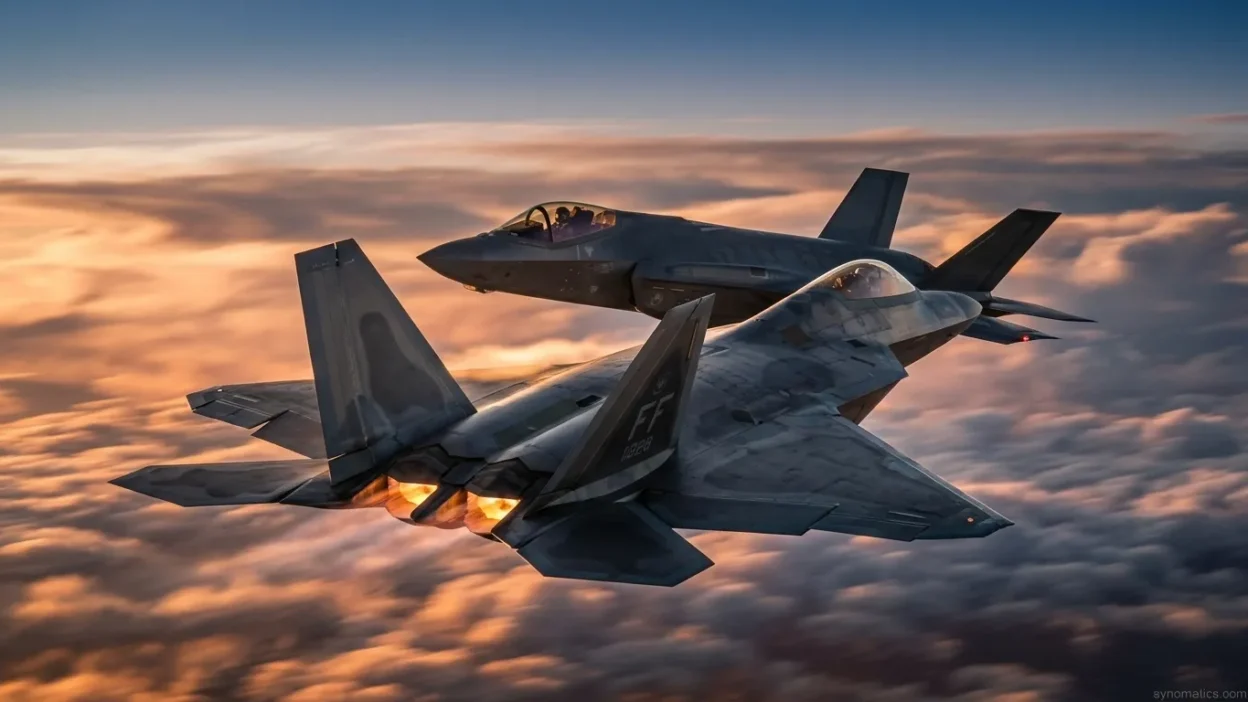
When comparing the Joint Strike Fighter vs F-22 Raptor, the biggest difference is their mission. The Joint Strike Fighter program produced the F-35 Lightning II, a multirole stealth fighter designed for air-to-air combat, ground attacks, and intelligence gathering. The F-22 Raptor, on the other hand, is primarily an air-superiority fighter built to defeat enemy aircraft and establish control of the skies.
Both aircraft use advanced stealth technology, powerful engines, and sophisticated sensors, but they serve different purposes in modern military aviation. The F-35 is available in three variants designed for different operating environments, including conventional runways, aircraft carriers, and short takeoff and vertical landing. The F-22 focuses more heavily on speed, maneuverability, and air-to-air performance.
Understanding the differences between these aircraft helps explain why comparing them is not simply a matter of deciding which fighter is better. Their effectiveness depends on the mission, supporting aircraft, weapons, and operational conditions.
Quick Answer
The Joint Strike Fighter, commonly associated with the F-35 Lightning II, is a versatile stealth fighter designed for air combat, ground attack, and intelligence missions. The F-22 Raptor is optimized for air superiority, featuring exceptional speed, maneuverability, and stealth. The F-22 generally has the advantage in dedicated air-to-air combat, while the F-35 offers greater multirole flexibility.
Why Do People Confuse the Joint Strike Fighter and F-22 Raptor?
People often compare these aircraft because both are American fifth-generation stealth fighters developed to maintain an advantage over advanced enemy aircraft.
They share several features:
- Stealth technology: Both are designed to reduce radar detection.
- Advanced sensors: Both help pilots detect, track, and engage threats.
- Internal weapons bays: Both can carry weapons internally to preserve their stealth characteristics.
- Modern avionics: Both use sophisticated computers and electronic systems.
- Multisystem integration: Both can work with other aircraft and military platforms.
The confusion comes from their similar appearance and advanced technology. However, their design priorities are different. The F-22 emphasizes air dominance, while the F-35 emphasizes versatility and information sharing across multiple mission types.
First Word: What Does “Joint Strike Fighter” Mean?
Joint Strike Fighter (JSF) is the name of the development program that produced the F-35 Lightning II family of stealth combat aircraft.
The word “joint” refers to the aircraft’s development for multiple military services, while “strike” highlights its ability to attack ground and other designated targets. The program aimed to develop related aircraft that could meet different operational needs while sharing many technologies.
The F-35 has three main variants:
- F-35A: Conventional takeoff and landing, primarily used by air forces.
- F-35B: Short takeoff and vertical landing capability, useful for suitable ships and shorter operating surfaces.
- F-35C: Designed for aircraft carrier operations, with features suited to carrier launches and recoveries.
The F-35 combines stealth, sensors, electronic warfare, and precision weapons in a multirole platform. It is designed to gather information, engage targets, and share data with friendly forces.
afnwc.af.mil
+2
Second Word: What Is the F-22 Raptor?
The F-22 Raptor is a fifth-generation American stealth fighter developed primarily for air superiority. Its central mission is to detect, engage, and defeat hostile aircraft while helping friendly forces control the airspace.
The aircraft uses two powerful engines, thrust-vectoring nozzles, advanced radar, and a low-observable design. It can cruise at supersonic speeds without afterburners under suitable conditions, a capability known as supercruise.
The F-22 can also perform certain ground-attack missions, so describing it as an aircraft that can only fight other aircraft would be inaccurate. Nevertheless, air dominance remains its defining role.
Unlike the F-35, the F-22 was not developed as a three-variant aircraft family for conventional airfields, short-runway operations, and aircraft carriers. Its design is more specialized toward high-performance air combat.
jble.af.mil
+1
Joint Strike Fighter vs F-22 Raptor: Comparison Table
| Feature | F-35 Lightning II (JSF) | F-22 Raptor |
|---|---|---|
| Main purpose | Multirole combat | Air superiority |
| Generation | Fifth generation | Fifth generation |
| Maximum speed | About Mach 1.6 for the F-35A | Mach 2 class |
| Engines | One | Two |
| Stealth | Yes | Yes |
| Supercruise | Not a defining capability | Yes |
| Air-to-air combat | Advanced capability | Primary design focus |
| Ground attack | Major mission | Secondary capability |
| Carrier operations | F-35C | Not designed for carrier operations |
| Short takeoff and vertical landing | F-35B | No |
| Sensor integration | A major strength | Advanced sensor fusion |
| International use | Operated by the US and partner or customer nations | Operated by the US Air Force |
The speed figures are published approximate specifications, not guarantees of performance in every flight condition. The F-35 figures also vary by variant.
Lockheed Martin
+3
When Should You Compare the Joint Strike Fighter and F-22?
The best aircraft depends on the mission being considered.
1. When Air Superiority Is the Priority
The F-22 is the more specialized choice for gaining control of the skies. Its combination of stealth, supercruise, maneuverability, and air-to-air weapons makes it particularly suited to this role.
2. When Multiple Missions Matter
The F-35 is designed to switch between air combat, ground attack, reconnaissance, and other mission requirements. Its sensor network and data-sharing capabilities are important advantages in complex operations.
3. When Operating From Aircraft Carriers
The F-35C is designed for conventional carrier operations, while the F-35B supports short takeoff and vertical landing. The F-22 is not a carrier-based aircraft.
4. When Speed Is the Main Consideration
The F-22 has the higher published maximum speed. However, maximum speed alone does not determine combat effectiveness. Detection, weapons, altitude, fuel, and tactical circumstances also matter.
5. When Comparing Overall Military Value
The F-35’s versatility and broad international user base make it valuable for joint operations. The F-22 offers a more specialized air-dominance capability. Comparing their value requires considering the aircraft, its support systems, maintenance requirements, and mission.
10 Examples of the F-35 vs F-22 Difference
These examples show how the aircraft’s different strengths matter in practical situations. They are illustrative scenarios, not predictions of the outcome of a real engagement.
- Intercepting hostile aircraft: The F-22 is purpose-built for air-superiority missions.
- Attacking a defended ground target: The F-35 is designed for precision strike missions in contested environments.
- Sharing battlefield information: The F-35 can combine sensor information and distribute it to friendly forces.
- Flying at supersonic speeds without afterburners: The F-22 has a documented supercruise capability.
- Operating from an aircraft carrier: The F-35C is designed for this task.
- Taking off from a short operating surface: The F-35B has short-takeoff and vertical-landing capabilities.
- Carrying out reconnaissance: The F-35’s integrated sensors support information-gathering missions.
- Combining stealth with air combat: Both aircraft use low-observable designs, but the F-22 is more specialized for air dominance.
- Supporting allied forces: The F-35 is operated by numerous US allies and partner nations, supporting multinational operations.
- Planning a mixed fighter fleet: A force could use the F-22 for air dominance and F-35 aircraft for a wider mix of strike, sensing, and combat missions.
The key lesson is that an aircraft’s best use depends on its intended mission, rather than one specification alone.
Aeronautica Militare
+3
Common Mistakes When Comparing the F-35 and F-22
Several misunderstandings can lead to inaccurate comparisons.
- Mistake 1: Calling the Joint Strike Fighter a completely separate aircraft from the F-35. The JSF program produced the F-35 family.
- Mistake 2: Assuming the F-22 cannot attack ground targets. It has a documented, although more limited, ground-attack role.
- Mistake 3: Assuming stealth means invisibility. Stealth reduces the likelihood or distance of detection under particular conditions; it does not make an aircraft undetectable in every situation.
- Mistake 4: Treating maximum speed as the only measure of superiority. Sensors, weapons, tactics, and support systems are also important.
- Mistake 5: Assuming every F-35 variant has identical capabilities. The A, B, and C variants have different operating requirements and design features.
- Mistake 6: Assuming the F-35 is simply a cheaper or less capable F-22. The aircraft were developed around different priorities, so that comparison oversimplifies their roles.
Memory Trick: How to Remember the Difference
Use this simple phrase:
F-35 = Many missions. F-22 = Air dominance.
Remember it this way:
- F-35: Think of a versatile tool designed for several different jobs.
- F-22: Think of a specialist designed to establish control of the skies.
This is a useful starting point for understanding their roles. It does not mean the F-22 cannot perform other missions or that the F-35 lacks air-to-air combat capability.
American vs British English
There is no significant American-versus-British spelling difference in the names Joint Strike Fighter, F-35 Lightning II, or F-22 Raptor.
Both American and British English use the same aircraft designations. Differences may appear in related terminology:
| American English | British English | Meaning |
|---|---|---|
| Airplane | Aeroplane | A powered fixed-wing aircraft |
| Air force | Air force | A military aviation service |
| Defense | Defence | Protection against attack |
| Maneuverability | Manoeuvrability | Ability to change direction or movement |
| Center | Centre | The middle of something |
These spelling differences do not change the aircraft’s specifications or capabilities.
Similar Words and Related Terms
Understanding these terms makes comparisons between modern fighter aircraft easier.
- Stealth fighter: An aircraft designed to reduce its detectability, particularly by radar.
- Air superiority: A level of control over the airspace that allows friendly forces to conduct operations with an acceptable level of interference from enemy aircraft.
- Multirole fighter: An aircraft designed to perform multiple types of combat mission.
- Fifth-generation fighter: A broad category of advanced combat aircraft associated with features such as stealth, integrated sensors, and modern avionics.
- Supercruise: Sustained supersonic flight without using afterburners.
- Sensor fusion: Combining information from multiple sensors to provide a more complete picture of the surrounding environment.
- Electronic warfare: The use of electromagnetic energy and related techniques to detect, disrupt, or protect against opposing systems.
- Precision strike: An attack designed to hit a specific target accurately.
- Thrust vectoring: Directing engine exhaust to help control an aircraft’s movement.
- Aircraft carrier compatibility: The ability to operate from a carrier using the appropriate launch and recovery systems.
FAQs:
1. Is the Joint Strike Fighter the same as the F-35?
Yes. The Joint Strike Fighter is the development program that produced the F-35 Lightning II family. The F-35A, F-35B, and F-35C are its three main variants.
2. Is the F-22 faster than the F-35?
Yes, based on their published maximum-speed figures. The F-22 is in the Mach 2 class, while the F-35 is rated at approximately Mach 1.6. Actual performance depends on flight conditions and configuration.
jble.af.mil
+1
3. Which fighter has better stealth, the F-22 or F-35?
Both have advanced stealth capabilities. Public information does not provide enough comparable detail to establish a definitive overall winner across all radar frequencies, detection systems, and operational conditions.
4. Can the F-35 defeat the F-22 in combat?
It is possible in principle, but no reliable conclusion can be drawn from aircraft specifications alone. The outcome would depend on detection, positioning, weapons, pilot decisions, supporting forces, and mission conditions.
5. Why was the F-22 developed if the F-35 also has air-to-air capabilities?
The aircraft have different priorities. The F-22 was developed primarily for air superiority, while the F-35 program emphasized a versatile aircraft family capable of performing several mission types.
6. Can the F-22 take off vertically?
No. The F-22 does not have vertical takeoff and landing capability. The F-35B, by contrast, is designed for short takeoffs and vertical landings.
7. Which aircraft is better for ground attacks?
The F-35 is designed with multirole and precision-strike missions as central requirements. The F-22 can also attack ground targets, but its defining mission is air superiority. The best choice depends on the target and operational requirements.
Ministry of Defence
+1
8. Which fighter is better overall?
Neither is better in every situation. The F-22 is more specialized for air dominance, while the F-35 offers broader multirole flexibility. The right comparison starts with the mission being evaluated.
Remember This
- Joint Strike Fighter refers to the program that developed the F-35 family.
- F-22 Raptor is a stealth fighter primarily designed for air superiority.
- The F-22 has the higher published maximum speed.
- The F-35 offers three variants for different operating environments.
- Both aircraft use stealth and advanced sensors.
- Mission requirements, not a single specification, determine which aircraft is the better fit.
Conclusion
The comparison between the Joint Strike Fighter and F-22 Raptor highlights two different approaches to modern fighter design. The F-22 concentrates on air superiority, combining stealth, speed, and maneuverability to help establish control of the skies. The F-35 focuses on versatility, integrating stealth, sensors, precision weapons, and data sharing into an aircraft family suited to different military services.
Ultimately, the F-22 is the more specialized air-dominance fighter, while the F-35 is designed to handle a broader range of missions. Understanding these differences provides a clearer picture of why both aircraft have important, complementary roles in modern military aviation.